

Following their 4-1 Ashes triumph over England, Australia will not play another Test until facing Bangladesh for two matches in the country’s north in August.
But from there, the next 12 months are packed with an extraordinary amount of long-form cricket, with the team set to tour South Africa, host New Zealand, head to India, play a one-off 150th anniversary Test against England at the MCG, and then travel to England for the 2027 Ashes … plus, in all likelihood, a World Test Championship final thrown into the mix.
That’s a potential 21 Tests in less than a year – and Australia are heading into it, despite all their recent successes, with serious question marks over a champion team now beginning to break up.
With an opener spot (and possibly two) to fill, a serious jostle for the all-rounder’s berth, and a swathe of fast bowlers all well and truly on the wrong side of 30, the next two years could be legacy-defining for this golden generation of Australian Test cricketers … or it could cause a disastrous end to an era and lead to a prolonged and painful rebuild.
Here are five burning questions for Australia to answer before the Test bonanza begins.
Does Travis Head stay as opener?
Surely … right?
Having spent years searching for an aggressive opening batter in the David Warner mould capable of changing the course of a match in the blink of an eye, Australia stumbled on the answer in the second innings in Perth, when Usman Khawaja’s back spasms opened the door for Travis Head to move to the top of the order, strike a match-winning 69-ball century, and turn the Ashes on its head.
Having requested the shift before Australia’s run chase began, Head has since expressed a preference neither for his newfound opening berth nor for a return to the middle order, maintaining his willingness to do whatever the team requires.
But Usman Khawaja’s return coming in the middle order mid-series speaks volumes, as does the weight of runs the South Australian cult hero scored for the summer – 629, to be exact, more than any player not named Steve Smith has managed in an Ashes in 12 years.
Head’s ascent to open the batting fixes so many issues. Most obviously, it gives Australia a dynamic, counterpunching opener they’ve lacked since Warner in his pomp, and while Indian and South African attacks will likely be more threatening with the new ball than England have been, the 32-year old is going to challenge any bowling unit in any conditions with his ability to score quickly and via unconventional methods.
The hidden benefit is that a now-vacant No.5 slot allows Australia a greater ability to ease in talented youngsters lower down the order and allow them to find their feet; where Nathan McSweeney was thrown to the wolves in the top order against Jasprit Bumrah last summer when that was the only spot on offer, now he or another up-and-comer (perhaps a Campbell Kellaway or Ollie Peake) can push into the generally easier batting conditions of the middle order without the need to sacrifice an all-rounder. Khawaja’s strong return in Adelaide batting at No.4, having struggled for more than 12 months opening the batting, suggests it’s not just fresh faces that can find the going easier further down the line-up.
Really, the only question mark against making Head’s move to the top permanent is whether it impacts the middle order’s ability to score quickly; but if Alex Carey can produce anything like his efforts with the bat through the Ashes, where he both scored plentifully and at a brisk pace to help mask Cameron Green’s struggles, even that shouldn’t stand in their way.
Travis Head celebrates after scoring a century. (AP Photo/Mark Baker)
… and who opens with him?
The Bangladesh series in particular looms as a golden opportunity for a fresh face to be given a look at international cricket ahead of higher-profile, more challenging overseas tours of South Africa and India in particular – not to mention the Ashes in 18 months’ time.
Brought in to partner first Khawaja and then Head for the Ashes, Jake Weatherald certainly hasn’t bedded down his spot; not only is an average of 22.33 with just one half-century for the series an ordinary return at the top level, but Head’s remarkable summer has left the primary reason for his ascension to the Test team – his ability to score quickly – rather obsolete.
Of the next tier down, Matt Renshaw again seems to be the most obvious candidate to usurp Weatherald. Not only has he already got Test experience under his belt, courtesy of a more than reasonable 12 months partnering Warner in 2016 and 2017, but he is also arguably the most in-form domestic batter in the country at the moment.
With three centuries in six Sheffield Shield innings at a princely average of over 70, only Marnus Labuschagne comes close to Renshaw’s first-class output; and while it’s a different format, a swashbuckling BBL campaign for the Brisbane Heat, featuring a remarkable century in a monster run chase and three further scores of above 40, are all the proof you need of how well he’s seeing them. At 29, he’s in his prime, and still with plenty of good years ahead of him, too.
Others have more question marks attached – Campbell Kellaway has had a breakout summer for Victoria and batted well for Australia A against the England Lions, but still has a first-class average of a tick over 30; Henry Hunt is a classic old-school bat all day opener, but averages 33 across six years for South Australia; Tim Ward tops the Shield run-scoring charts this year, but the Tasmanian has only three first-class hundreds in 44 games; Sam Konstas has mixed the exhilarating with the unwatchable across formats and surely needs more time to refine his technique, and selectors don’t seem wedded to his high-risk style given he wasn’t trusted for the World Test Championship final last year.
It’s unwise to discount Labuschagne as an option to reprise his opening role from the WTC final, which would allow, say, McSweeney to take up the No.3 spot he bats at for South Australia; but the Queenslander’s spot in the team is far from secure after his own middling summer, and should that continue for too much longer the temptation to try and find someone new for at least the 2027 Ashes may prove irresistible.
Australian selectors aren’t exactly spoiled for choice, but there are a whole lot of options out there – some conservative, some with high risks to go with their high rewards. Pulling the right rein at the right time won’t be an easy task.

Marnus Labuschagne. (AP Photo/James Elsby)
What to do about Cameron Green?
Long the next big thing of Australian cricket, Green finished the Ashes looking like a man in desperate need of a return to first-class cricket to build up some confidence at a level he has previously dominated ahead of the challenges ahead.
The problem is that he won’t play another red-ball match until the Bangladesh series, with the T20 World Cup taking him out of contention for Western Australia at Sheffield Shield level, before his monster IPL contract takes effect for this year’s tournament. He has also already confirmed he won’t be playing county cricket, presumably out of a desire from Cricket Australia to prevent his injury-prone body from another breakdown.
Australia have been lucky so far in that their near-constant success since Green joined the team in 2020/21 – that summer’s 2-1 loss to India and defeat in the 2023 tour of the same country are the only series he has lost as a Test cricketer – has allowed them to carry him in the team, ride out his struggles, and give him all the time in the world to find his feet.
But continuity has always been a struggle – a triumphant tour of New Zealand in early 2024 saw him appear to have cracked the top level, only for him to go more than a year without another Test, then shunted up to No.3 for the WTC final and a treacherous tour of the West Indies, before a summer in which he batted everywhere from No.5 to No.8 and never bedded down a spot.
Bowling-wise, he seldom shook off the rust of his year on the sidelines, though his pace was reasonable all summer long; a five-wicket haul on Boxing Day against South Africa three years ago remains his only Test five-for, and a record of barely a wicket per Test doesn’t inspire confidence he’s the high-quality fourth seamer he has been purported to be.
A nervous starter who has publicly stated he prefers the extra pace and nip of facing a new rather than older ball, there’s no question Green is an inferior batter right at this moment to his main all-rounder rival, Beau Webster – a view bedded down by the Tasmanian’s classy half-century in his only innings in Sydney. While boasting a far less glittering Sheffield Shield record than the Western Australian, Webster has proved himself a cool head under pressure ideally suited for the high intensity of Test cricket. It would be foolish to axe him again without a prolonged run of poor form at Test level.
Even with Webster in the team, though, there’s a free No.5 spot in the Test side up for grabs with Khawaja’s retirement. Labuschagne’s first drop, which Green inherited in the West Indies and made a reasonable fist of, might also be an option.
Barring injury, he’s a lock for one spot or another to face Bangladesh in August – even if a senior head like a Steve Smith needs to be rested out to ensure it happens.
But a poor run in those matches – especially if Webster can continue to make his chances count – could very, very easily leave his spot untenable going into the tour of South Africa. And as Webster himself discovered this summer, as did Green when Mitchell Marsh leapfrogged him in 2023, once out of this team, it can be tough to get back into it.
Do more quicks need to be blooded?
Head, Carey and Mitchell Starc were the undisputed stars of the summer – but don’t discount how crucial Scott Boland and Michael Neser were to the Ashes being successfully retained.
Pat Cummins and Josh Hazlewood playing just one Test between them would have spelled doom at the start of the series, but at 36 and 35 years old respectively, Boland and Neser were the perfect foils for the champion pair, with their skillsets honed by years of dominating the Sheffield Shield vindicating the selectors’ decision to invest in experience as back-up for the golden trio.
Here’s the problem, though: the fast-bowling quintet of Boland, Neser, Starc, Cummins and Hazlewood will all be at least 34 by the end of the 2027 Ashes, and Boland will be 38. Not an ideal age mix for a 12-month period of 21 Tests, and one that will require substantial juggling – especially when you throw into the mix Nathan Lyon, whose cricketing mortality has never loomed larger than when he limped off the Adelaide Oval with a torn hamstring mid-series (more on him later).
Australia have been fortunate in that none of Starc, Boland or Neser have shown any signs of extreme wear and tear this summer despite their ages – Starc in particular looks like he could go another five Tests.
But it would be imprudent to not continue to keep Jhye Richardson there and thereabouts for Test opportunities: if not for right now, then for the immediate post-Ashes future. The last thing anyone wants is for two or even three of that quintet to retire at around the same time, leaving gaping holes in an XI with an already ageing batting line-up.
Beyond Richardson? It’s hard to know. Lance Morris was once the next big thing in Australian fast bowling, but the West Aussie quick can barely get on the park these days; Fergus O’Neill has an impeccable first-class record but without the pace that usually turns heads in this part of the world.
Brendan Doggett, another 30-something option, showed in two reasonable but not earth-shattering Tests as the next cab off the rank this summer that the depth is fragile beyond the same bowlers who have been there and thereabouts for the last six years.
It’s a delicate balancing act, not least because the end of the 2027 Ashes looms as an ideal stopping-off point for any or all of Starc, Hazlewood and Boland at least. If selectors continue to stick to a ‘best available team’ approach, there’s every chance at some point in the future, an Australian bowling attack will need to be rebuilt from the ground up for the first time in decades.
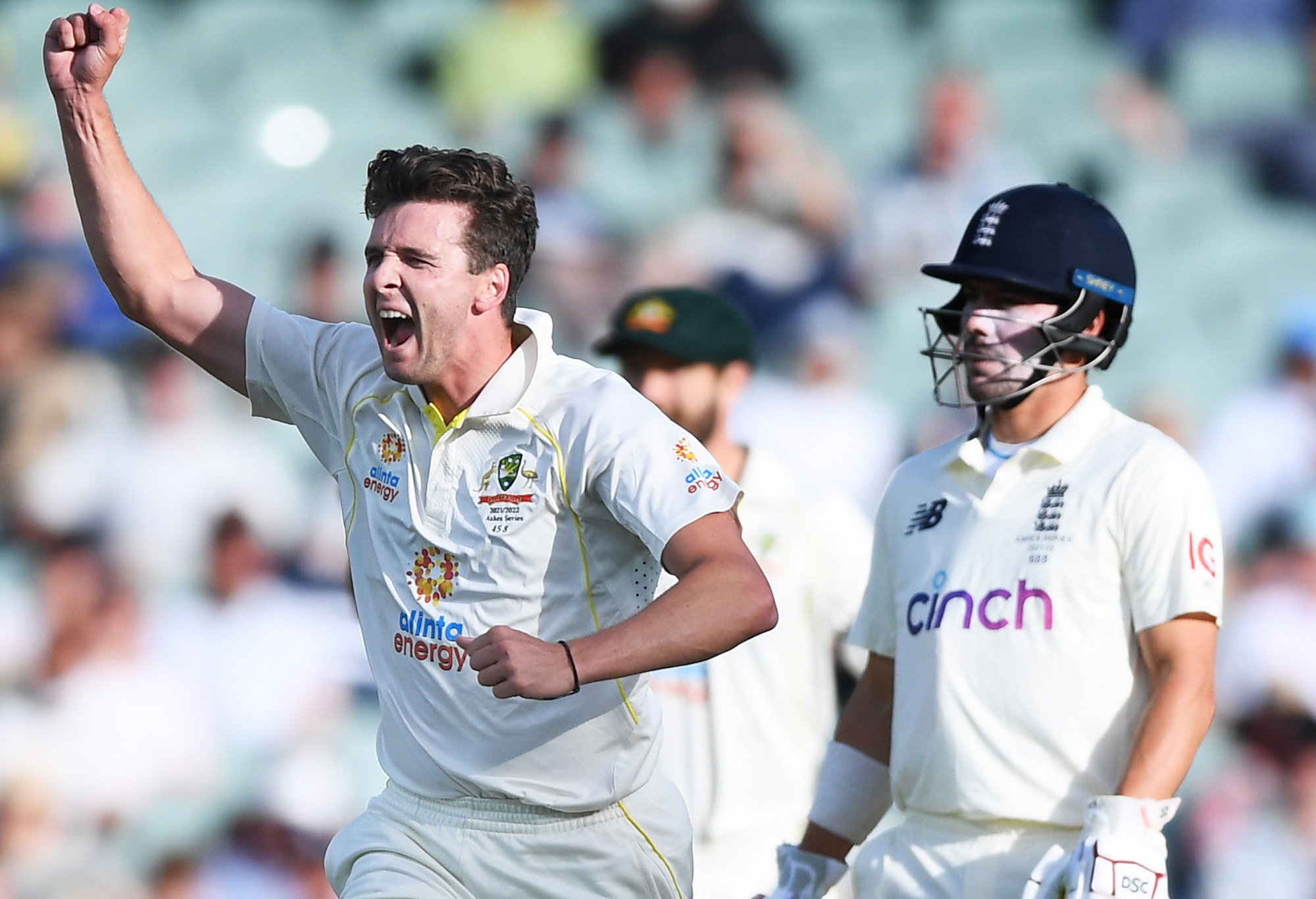
Jhye Richardson celebrates the wicket of Haseeb Hameed in 2021. (Photo by Mark Brake – CA/Cricket Australia via Getty Images)
Who is Nathan Lyon’s heir apparent?
If there’s one area of concern for Australia greater than the future of the batting order and the pace attack, it’s the identity of the next spinner.
Indeed, it’s a question even thornier than it was 19 years ago, when Shane Warne bowed out – at least then, selectors (mistakenly) thought Stuart MacGill would be around to carry the can a while longer.
It would be a surprise to not see Lyon, fitness notwithstanding, featuring in all 14 of Australia’s upcoming overseas assignments in South Africa, India and England. In India in early 2027, especially, he will play a starring role for likely the final time.
But since his hamstring injury in Adelaide, the Aussies have twice foregone an opportunity to look at Todd Murphy as his replacement – understandably so on a Melbourne minefield, inexplicably on a classic Test match pitch at the SCG.
To go with his omission for the fourth Ashes Test in 2023, that’s three times already in Murphy’s young career where selectors have decided going in with no spinner is better than having him in the XI. By contrast, it has taken over 14 years for Lyon to match that count of omissions in favour of a four-man pace attack, with two of them coming in 2025.
Australian pitches won’t remain this pace-friendly forever. Indeed, after the MCG debacle this summer, there’s every chance we’re about to go into a generation of batter’s paradises. Should that happen, then a containing, patient and crafty spinner – Lyon in a nutshell – will be of paramount importance.
If Murphy isn’t that guy, then is it Corey Rocchiccioli? Matt Kuhnemann, on more than just subcontinent tracks? A return to Mitchell Swepson, Australia’s first full time Test leg-spinner since MacGill?

Todd Murphy. (Photo by Stu Forster/Getty Images)
Lyon is part of a golden generation winding down, in a similar vein to the spate of retirements from January 2007 over the following two years that took Australia from top of the world to years of chaos and confusion.
At least then, though, plans were in place, as ill-fated as some of them were: MacGill would fill the Warne void, Stuart Clark was the next Glenn McGrath, Phil Jaques had already been blooded as a Justin Langer-esque opener.
21 Tests in 12 months offers an ideal opportunity to begin tentatively planning for life after Starc and Lyon, beyond Steve Smith, with a fresh batting order and a keen crop of youngsters desperate to seize their chance.
Only time will tell whether the powers that be are willing to risk an eventual capitulation to try and get this group of greats to one last spree of glory.
One way or another, the choices they make – and how those five questions are answered – will define the next decade of Australian cricket.
Tim Millerhttps://https://ift.tt/apnSNF3 opens, Lyon’s heir, and what to do about Green? Five burning questions for Australia ahead of 12-month Test bonanza
Post a Comment