

The Queensland Reds might have shown a willingness to attack at all costs under Les Kiss, but Eddie Jones believes the incoming Wallabies coach will instead focus on shoring up the side’s defence in the lead-up to the 2027 World Cup.
In a wide-ranging conversation around where Australian rugby is currently at, Jones said the Wallabies had “developed really well” under Joe Schmidt despite their horror finish to 2025.
But the former Wallabies coach, who took Australia to the 2003 World Cup final but bombed out 20 years later in his second coming in the role, said his home nation was still struggling with consistency because of the inherent flaws in the game.
“If I was an Australian fan, and I am, I’d be full of hope for the team going forward,” Jones said on the Rugby Unity podcast alongside David Pembroke.
“But the problem is they’ve still got a systemic problem, mate, which they failed to deal with.”
Jones, who quit as Wallabies coach less than 12 months into a five-year deal in late 2023 in part because of its failure to move on promises to fix the state of the game, said Rugby Australia had to consolidate its resources.
“The most obvious is to centralise your resources,” he said.
“Probably have three teams and one development team. And that development team could be the Force, where you put all your young players who need to play Super Rugby on a regular basis.
“All your best players in the top three teams; Waratahs, Reds, Brumbies.
“Make sure you’ve got fantastic academies associated with those and satellite academies.
“And you’re spending more money making sure that you’re picking up the best young players at the developmental ages around 15, 16. You’re not letting those players slip through to Rugby League, the ones you want to keep. And then it will flow from there.
“I don’t think it’s too complicated. The complication is the politics, which is always the thing, particularly in Australian rugby. It’s the politics that stop common sense in terms of development.”
Rugby Australia’s brains trust, including director of rugby Peter Horne (L), outgoing Wallabies coach Joe Schmidt (2nd L), incoming Walabies coach Les Kiss and CEO Phil Waugh (R). (Photo by Matt King/Getty Images)
Jones said the nation’s lack of depth had hurt the Wallabies kicking on under Schmidt, who helped mastermind the nation’s third Test win over the Lions and victory at Ellis Park two weeks later over the back-to-back world champion Springboks.
The end of year struggles occurred after the Wallabies lost Tom Wright, Tate McDermott, Will Skelton and Langi Gleeson to injury, while stalwarts James Slipper and Nic White retired following The Rugby Championship.
“Well, they started the season with a couple of ordinary performances. Had a really good mid-season, didn’t they? You know, they played well in the Lions, taking the third Test of the Lions season, at the start of the Rugby Championship, and then sort of petered out since then,” Jones said.
“I think it goes down to [what] Joe Schmidt’s been talking about, [which is] the lack of development of players in Australia.
“I just don’t think they’ve got the depth of other countries, and that’s resulted in them not declining, but not going forward as they would have hoped.”
The impending coaching handover next August, where Kiss will replace Schmidt following July’s three Nations Championship fixtures, has also clouded the direction and momentum of the Wallabies.
But Jones, who has known Kiss for two decades, said from his experience with the former Maroons and Kangaroos winger, he expected the former rugby league star to bring back a stronger emphasis on defence – the role he held with the Springboks and Ireland, before moving into a head coaching role.
“He understands the rigours of professional coaching, and I think he’ll be very well organised,” Jones said.
“He’ll have a clear view of how he wants to play the game.
“He’s always been a more defence-minded coach.
“He’s always coached the defensive side of the game, so it’ll be interesting to see whether he takes that defensive mindset to the Australian team.”
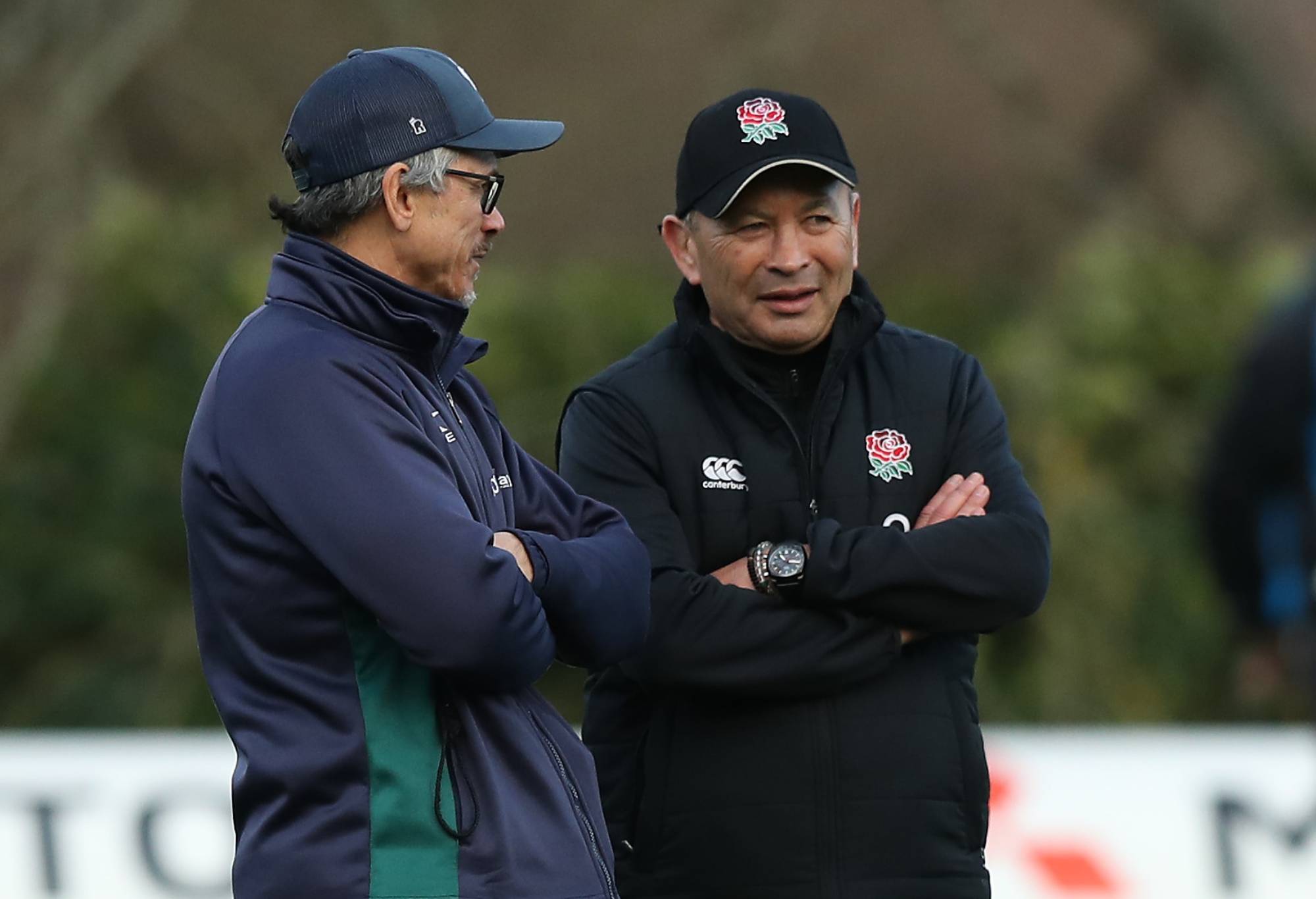
Eddie Jones (R) talking to Les Kiss at Pennyhill Park on February 20, 2019 in Bagshot, England. (Photo by David Rogers/Getty Images)
Jones pointed to the success of Rod Macqueen, who had John Muggleton play a key role with his side in hardening the team’s defence.
It led to the Wallabies, who had one of the best backlines in the world and generational players, including George Gregan, Stephen Larkham, Tim Horan and Joe Roff, conceding just one try throughout the entire tournament.
“That’s not to say that the Australian side didn’t [attack], but they had a much more defence-focused mindset, and it’ll be interesting to see whether Les brings that to the Australian side and tries to create this much more defensive-minded [attitude],” Jones said.
“The Australian players, to me, have always liked to attack. We like to take the opposition on, we like to show how clever and strong we are with the ball. So, I think that’ll be one of the things to assess pretty early.”
Put to him that the Reds regularly turned down shots at goal under Kiss and liked to take the game on, Jones reiterated that he thought Kiss would prioritise the defensive side of the game initially and would likely bring back some more line speed.
“I think teams either have an identity around defence or identity around attack, and I think the Australian side’s identity has generally been around attack,” Jones said.
“And it’ll only be a subtle shift, and it’s only a nuanced change. But it’ll be interesting to see whether that comes forward, and you’ll maybe see with that a little bit more line speed from Australia, a bit more aggression, because under [defence coach] Laurie Fisher, he plays that more connected defence, stay connected.
“There’s two ways of going about it. You either go line speed, or you go connectiveness, or you go in between, and maybe Australia’s tended to be more connected, and whether Les will bring a more aggressive approach to a bit more line speed, which has its risks, because then you tend to defend a bit narrower, and the outside space can be exposed.”
Jones said Kiss would face a baptism of fire when he takes over 14 months out from the World Cup on Australian shores, but added there were some positives of taking over so late in the piece and guiding the Wallabies into a home tournament.
“It’s a difficult time for him to take over,” he said.
“He’s taking over a team that hasn’t done well for a period of time now and he’s coming in halfway through the season.
“Allow him to find his feet, allow him to get his feet under the table and find out what sort of team he can produce for the World Cup in 2027.
“Because one of the things he’s got massively in his favour, mate, massively, is having a home World Cup. That is a massive advantage. Players are highly motivated. Players will not think about doing a little bit extra or think about doing extra, because it’s a once-in-a-lifetime opportunity for players.
“For a head coach, it’s a once-in-a-lifetime opportunity coaching your home team at a home World Cup.
“You’ve generally got the community behind you, supportive, and you’re the centre of the stage in Australia for that period of time.
“There’s no better opportunity to coach, no better opportunity to play and perform. There’s a lot of advantages there.
“And the referees help you. That is a key factor. And I don’t mean that in any sort of untoward way, but if you just look at decisions, particularly on TMOs in the recent Tests, the influence of the home crowd has a massive [impact] and that’s just natural.”
Christy Doranhttps://www.theroar.com.au/2025/12/02/massive-advantage-ex-wallabies-coach-predicts-subtle-change-under-kiss-and-big-reason-he-should-succeed/‘Massive advantage:’ Ex-Wallabies coach predicts ‘subtle change’ under Kiss – and big reason he should succeed
Post a Comment