

What is the best way for Australia to beat England in a rugby union match in London? Make England play most of the rugby, soak up the pressure, stop attacks at source, slow or foul the ruck and kick the ball in awkward spots.
Since starting to play Tests against each other in 1909 the Wallabies have played England at Twickenham 29 times. The average score? 19-16.
In the 11 matches won by Australia at Twickenham, the home side only once scored more than 15; about half the time they were in single digits.
The immediate takeaway is how closely related wins over this old foe (in England) are to Wallaby defensive brilliance, not hard pitch big scoring.
In contrast, when England has beaten Australia lately, the hosts have scored freely (40, 32, 37, 25, 30, 37, 40, and 39 points among the last ten wins) with the lowest in London being 20 in 2013. An English score between 15 and 20 appears to be a zone of Aussie interest.
Some of the greatest moments in Australian rugby history are founded in stingy defence, ruck negation, lineout steals, and desperate cover tackles. In 1987, held England to six points at Concord Oval in Sydney, to six points in the 1991 World Cup final as the Wallabies took the crown, and forced Jonny Wilkinson to make an extra time drop goal in 1999 to take the Cup, squeezed South Africa in a 2011 quarter-final dominated by David Pocock, and the best Bledisloe Cup results in the last decade or so have correlated with keeping the All Blacks under 20y points.
(Photo by Will Russell – RFU/The RFU Collection via Getty Images)
But what about running rugby, Randwick, the Australian Way, and keeping hold of the pill so that England cannot score? Mostly a myth, but also, if it does return, it will take time.
The All Blacks, whose attack can be charitably described as a bit better than Australia’s (22 tries versus 11 in The Rugby Championship, 44 clean breaks versus 26, 45 more defenders beaten, and 30 more offloads completed) just played the very same starting XV (albeit with Ollie Lawrence and Henry Slade swapping shirts, to try to overcome clunky midfield results).
Potent New Zealand scored just 24 points, mostly from low phase and highly efficient strike moves. In the end, despite scoring three tries, the Kiwis were forced to watch two makeable English kicks miss the mark to hold on to win.
There is a better way.
England was able to hold on and even go up eight points with 14 minutes to play by sheer negation of multi-phase attack.
Their turnovers from dominant tackles or jackals came with metronomic regularity. Had Maro Itoje’s textbook steal at minute 66 stood (Ben Earl did what many of us might when faced with massive loosie-turned-prop Pasilio Tosi on the charge and took a dive) England would have likely gone on to win.
They refused to play too much rugby: kicking 33 times, often finding grass or touch, and building less than 70 rucks. The All Blacks passed 211 times and one of those went to Marcus Smith who built the lone English try almost like a kick return counterattack. England only passed the ball 103 times; two of which were in that try.
The hosts got on the right side of the referee early, using that for territory. The gaudy All Black attack stats had heavy ballast: turnovers at a record rate.
Can the Wallabies score more tries and points than the All Blacks at Twickers? Likely not.
But the English attack does not look that difficult to defend; not as hard as stopping the Springbok, All Black or Puma schemes at least. The Wallabies shipped 35 points a match in The Rugby Championship this year and averaged 18 points for, with the most enduring image the lack of cover or scramble on opponent breaks.
Make England play more rugby.
For this match, Joe Schmidt should focus on the area with the most possible improvement (defending a stilted English attack) rather than try to build phases against a team that loves to soak and counter, not construct moves.
Lawrence is a serious operator but only had two carries against the All Blacks, both in the first 11 minutes. In the last three Tests, England has only managed to feed this destructive carrier 11 times!
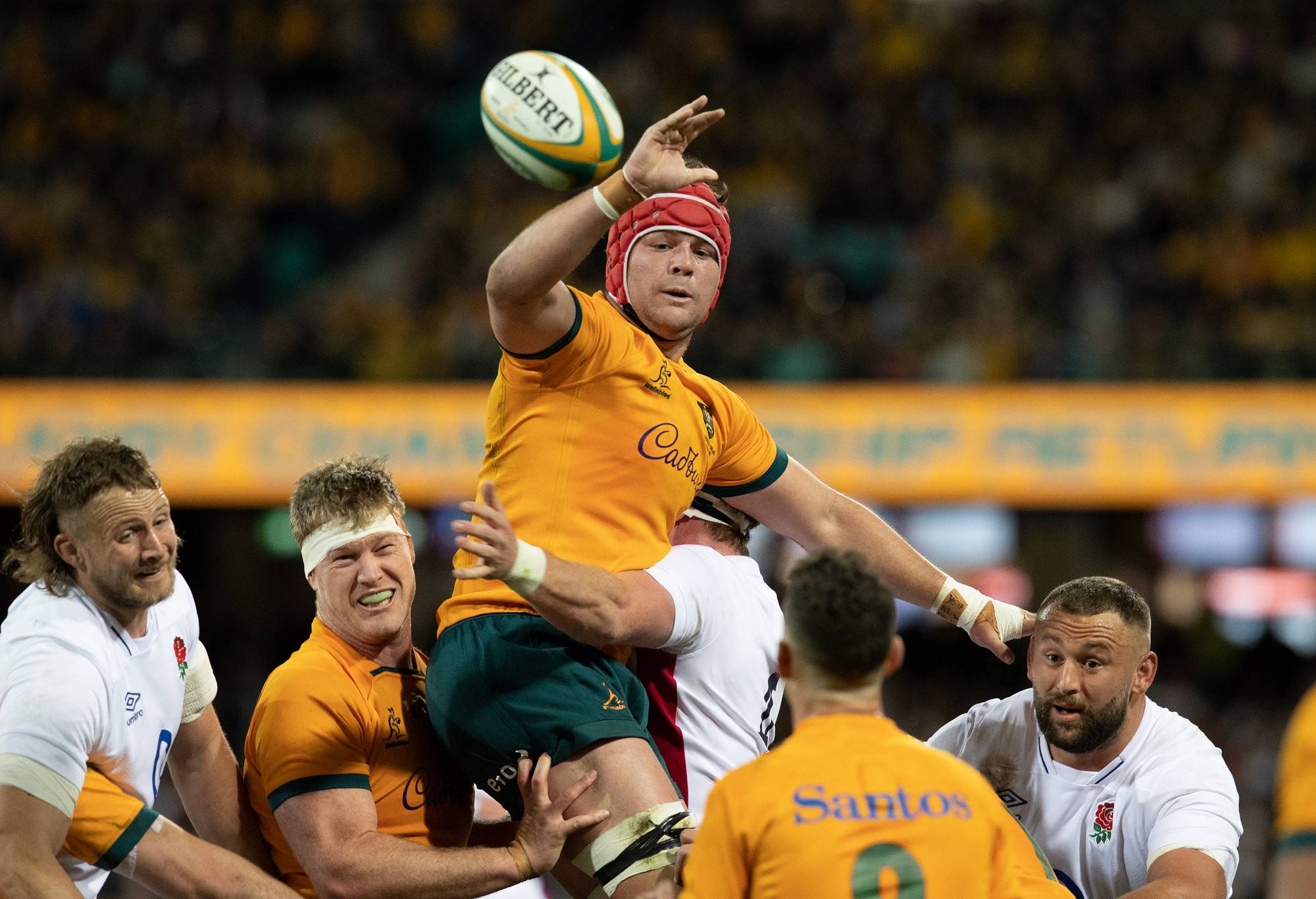
(Photo by Steve Christo – Corbis/Corbis via Getty Images)
The ability to get the ball to the third receiver on attack moves is something the best teams have.
England cannot seem to bring a lethal back three into phase play. Immanuel Feyi-Waboso is a threat but essentially disarmed or dependent on broken play chances.
In the Six Nations this year, England carried less than 100 times a game, made 350 fewer passes than Ireland, completed the fewest offloads (18 versus Scotland’s 47), and had one of the slowest rucks in the competition. But they scored tries off the counter, creating line breaks through the blitz turnover, and caused opponents to commit penalties (and used that advantage to score), knock the ball on, and be carded.
Do the 2024 Wallabies seem more able – away at HQ – to score 25 or 30 points or hold 2024 England to fifteen or so?
I contend the 15 is more feasible than the 30.
The referee for this afternoon fixture is Ben O’Keeffe, who is known for three things: pre-match homework and analytics, having his overall in-game statistics in mind, and making the unpopular calls (almost all correct) for the visitor in the seething cauldron that was the Stade de France last year which led to the host being knocked out of their own Cup.
His previews cover “what is common to their style” for each team so that he can get in the best refereeing positions.
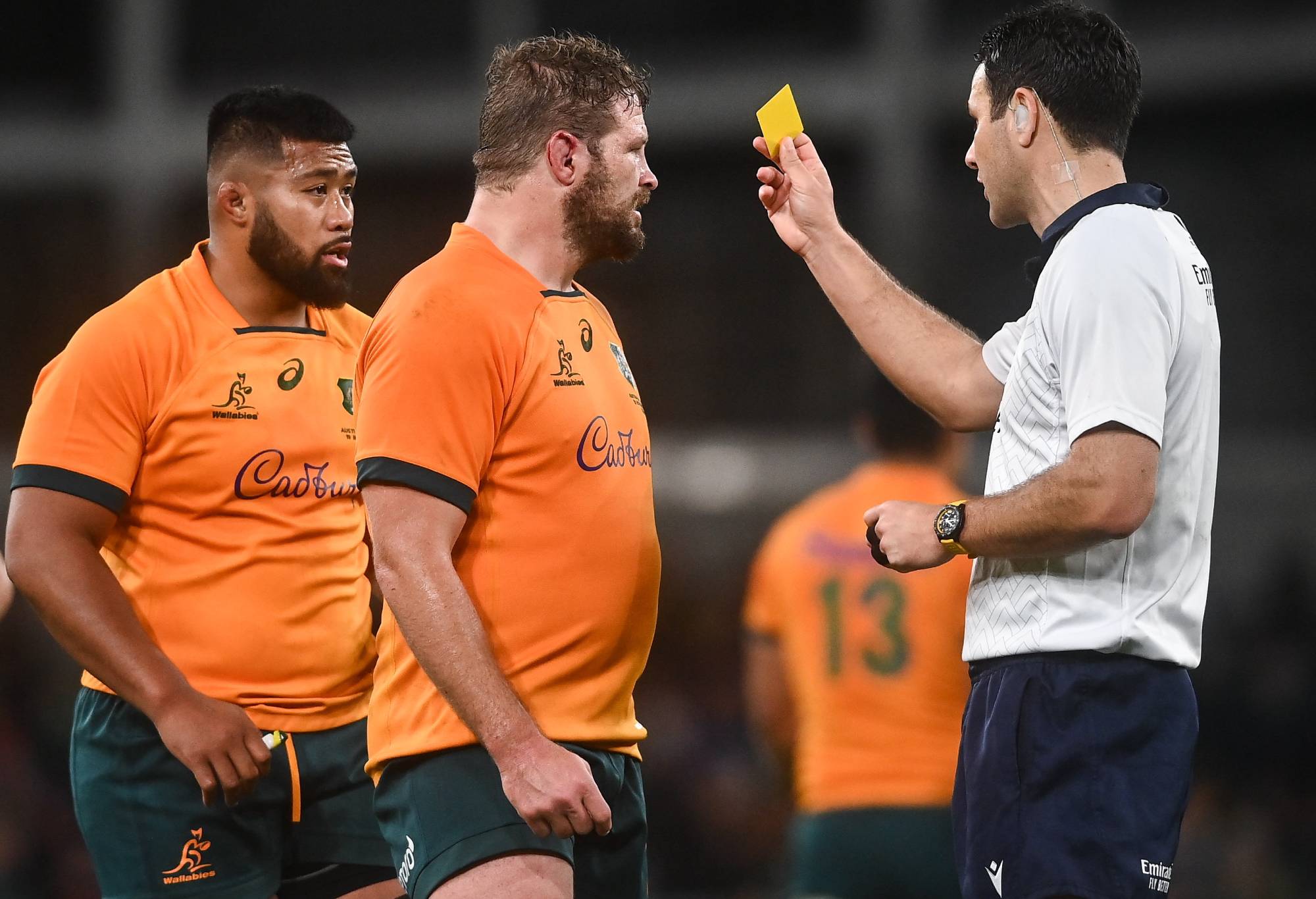
(Photo By David Fitzgerald/Sportsfile via Getty Images)
His feel for his own stats in a match cover whether he is missing a particular offence (like a side entry at breakdown) or the telltale “supporting body weight” jackal.
Enter the three finalists for the John Eales Medal this year: all of whom well known to Mr. O’Keeffe.
Fraser McReight is an Australian cattle dog, claims the Wallabies official site, along with calling him the “heir apparent to Michael Hooper.” But as much as his link play reminds us of the omnipresent Waratah man, this youngster seems more a descendant of a certain senator from a mountain town down the way and Liam Gill, the “one that got away.”
An old-fashioned gunfight at the cabbage patch corral beckons: Tom Curry versus McReight on who can read O’Keeffe’s mind better.
My dollar is on the Red.
His good mate Harry Wilson is more of a soldier of the back row, taking on the settling runs and cleans which must be made but do not always make highlights. It is their tandem sense of where each other are which is the key to a breakdown masterpiece. Wilson is a captain’s captain and will provide a welcome contrast to O’Keeffe from bombastic Earl, his opposite number and personality type.
Joining them is power-runner Rob Valetini who won the Medal for the second year in a row and is only 26. He is the best carrier in a team not awash in go-forward ball but he is also an underrated smash tackler. Turnovers flow more easily from dominant tackles and Valetini lines foes up. He will not step back from the impressive Chandler Cunningham-South at blindside; nor even Itoje.
Add in the Wallaby props who are no slouch at the ruck and the seeds of a famous smash-and-grab job are planted in the mind. The battle of the breakdown, if it results in a pinged, slowed, and frustrated setup for Marcus Smith, will also allow the visitors to eat up time and get deep into the Test with a chance.
Teams which cannot close out a match, as England has shown a propensity to do lately, can heap pressure on themselves by trying too hard.
Who knows but it might be Smith or Slade tossing an interception to a flying wing?
Harry Joneshttps://https://ift.tt/JrpZaKM England play more rugby: Why defence will be the best form of attack for the Wallabies
Post a Comment